BirdBrain is part of the CreXo family of brands!
Learn MoreBirdBrain is part of the CreXo family of brands!
Learn MoreIn today's digital landscape, computational thinking skills are vital for success across various sectors. According to a report from the World Economic Forum, 75 million jobs are expected to be displaced by automation by 2022. However, 133 million new roles will emerge that require strong analytical and problem-solving abilities. This shift highlights the importance of instilling computational thinking in education and training.
Moreover, a study by the International Society for Technology in Education found that 49% of educators believe computational thinking is essential for student readiness. These skills allow individuals to formulate problems, analyze data, and create solutions—capabilities increasingly demanded in the workforce. Yet, many educational systems struggle to integrate this learning effectively, leaving gaps in students’ skillsets.
Reflecting on the current landscape, it's important to realize that not all students are gaining equal opportunities to develop these skills. As we move towards a technology-driven future, ensuring access and quality of computational thinking education remains critical. Addressing these disparities can foster innovation and equip the next generation with tools they need for success.

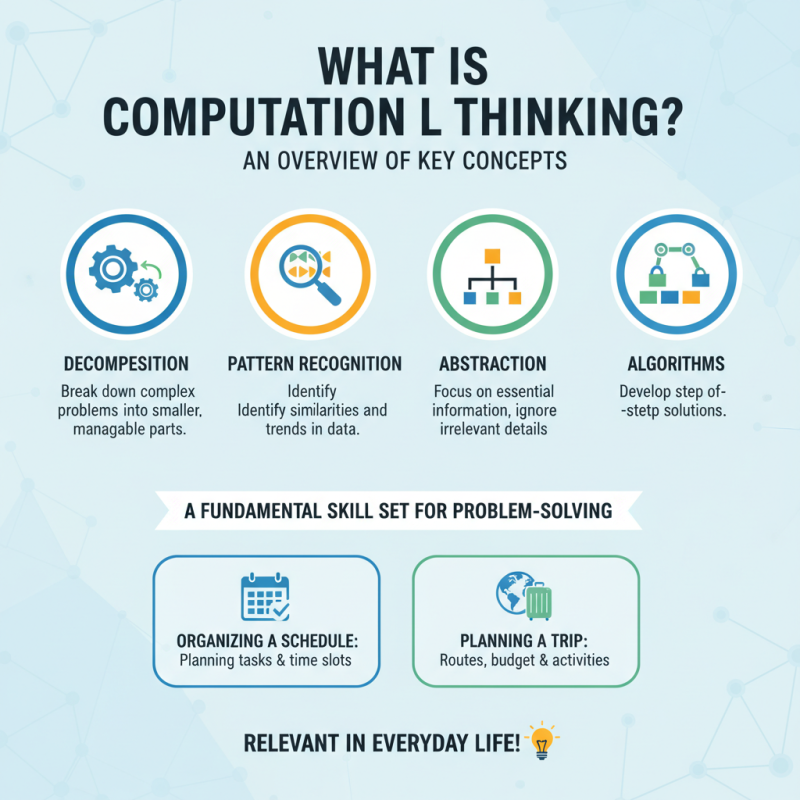
Computational thinking is a fundamental skill set for problem-solving. It involves breaking down complex problems into manageable parts. This skill is not just for computer scientists. It is relevant in everyday life. For example, organizing a schedule or planning a trip can benefit from this mindset.
Key concepts of computational thinking include decomposition, pattern recognition, and algorithm design. Decomposition means taking a large problem and sharpening the focus. For instance, planning a meal involves choosing recipes, gathering ingredients, and cooking times. Each of these steps is a mini-problem requiring attention.
Pattern recognition looks for similarities among problems. This can lead to solutions based on past experiences. Algorithm design entails creating a step-by-step solution for a problem. These skills empower individuals to think analytically. They enhance creativity and innovation. While computational thinking is vital, many people find it challenging. Learning to adapt these skills takes practice and patience. There is always room for improvement. Embracing the journey of mastering these skills can lead to meaningful outcomes.
Computational thinking is essential in today’s digital world. Its four pillars—decomposition, pattern recognition, abstraction, and algorithms—help us solve complex problems effectively.
Decomposition breaks down large problems into smaller, manageable parts. For example, when designing a website, you might split the project into sections like layout, color scheme, and navigation. This makes daunting tasks seem easier and more achievable.
Pattern recognition identifies trends and similarities. By observing how certain code structures lead to similar outcomes, you can apply these insights to new challenges. Abstraction allows you to focus on important elements while ignoring irrelevant details. This simplifies complex systems, making them easier to understand. Finally, algorithms provide step-by-step solutions to problems. They are not always efficient, and creating them can require trial and error.
These pillars work together to develop a deeper understanding of technology and logic. Embracing them can enhance both personal and professional growth in various fields.
| Pillar | Description | Real-World Application |
|---|---|---|
| Decomposition | Breaking down complex problems into smaller, manageable parts. | Project management and software development. |
| Pattern Recognition | Identifying trends or regularities in data. | Data analysis, market research. |
| Abstraction | Filtering out unnecessary information to focus on the essential features. | Creating models and simulations. |
| Algorithms | Developing a step-by-step solution to a problem. | Computer programming, decision-making processes. |
The integration of computational thinking in education has emerged as a vital trend. Recent statistics show that schools implementing these skills notice a marked improvement in problem-solving abilities among students. Educators recognize that teaching these skills is not just about technology; it's about fostering a mindset for analytical thinking.
Many students struggle to grasp complex concepts without the framework of computational thinking. This struggle indicates a gap in traditional teaching methods. Educators must find innovative ways to integrate these skills earlier in the curriculum. Statistics reveal that 70% of students benefit significantly from lessons focused on logic, algorithms, and pattern recognition. These skills are crucial across various disciplines.
While progress is evident, challenges persist. Teachers often lack adequate training in delivering computational thinking curricula. The need for specialized professional development programs is clear. Additionally, students who face socioeconomic barriers may not have the same access to technology, widening the educational gap. Addressing these issues will be essential for preparing future generations to thrive in an increasingly digital world.
Computational thinking (CT) has become essential across many industries. In healthcare, for instance, data analysis helps identify disease patterns. According to a report by McKinsey, AI could potentially save the healthcare industry up to $150 billion by 2026. This is largely due to improved diagnostic tools that rely on CT skills for data interpretation and problem-solving.
In finance, computational thinking aids in risk assessment and fraud detection. A study from PwC highlights that banks employing advanced analytics can reduce fraud losses by 80%. By utilizing algorithms and predictive models, financial institutions can better manage risk and enhance their decision-making processes. However, many professionals still struggle with applying CT concepts effectively.
Manufacturing also benefits from CT through automation and process optimization. A report by the World Economic Forum indicates that advanced robotics and AI could add $14 trillion to the global economy by 2030. Yet, not all companies are adapting quickly enough. Embracing computational thinking skills could bridge the gap, allowing businesses to leverage technology more efficiently. The challenge lies in upskilling the workforce to meet these evolving demands.
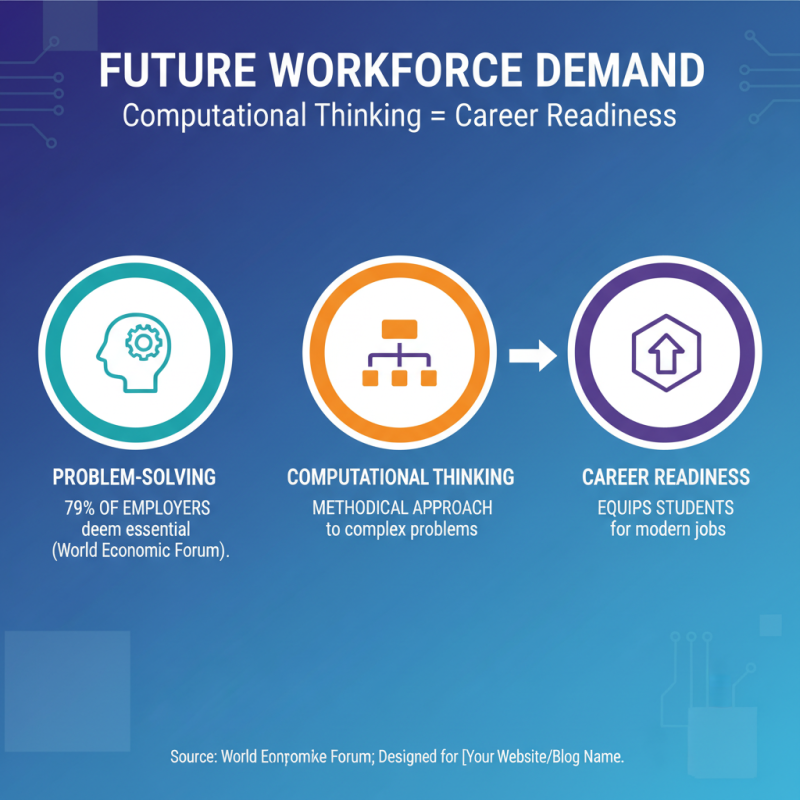
In today’s job market, computational thinking skills are increasingly vital. The World Economic Forum highlights that 79% of employers believe that problem-solving skills are essential for career readiness. This emphasizes the necessity of fostering computational thinking in education, as it equips students with a methodical approach to tackling complex problems.
The demand for workers proficient in these skills is clear. According to a report by the US Bureau of Labor Statistics, careers in technology and data analysis are projected to grow by 31% by 2029. However, many educational institutions still struggle to integrate computational thinking into their curriculums. This gap leads to a workforce that may lack critical skills for future jobs.
Many individuals face challenges in adapting to this shift. While some grasp computational thinking easily, others find it difficult due to limited exposure. The contrast highlights a need for effective teaching strategies. Emphasizing hands-on projects can help learners connect theoretical knowledge with practical applications. Evaluating current teaching methods can reveal areas for improvement, ensuring that all students are better prepared for the demands of the future workforce.
To provide the best experiences, we use cookies to store and/or access device information. Consenting to these technologies will allow us to process data such as browsing behavior or unique IDs on this site. Not consenting or withdrawing consent, may adversely affect certain features and functions.